Category Archives: Uncategorized

The (Inter)national Brain Drain

Brain drain is a sadly well-known phenomenon in many countries and it usually refers to an international flow of high-skilled workers from some countries to countries that for some reason are more attractive. The mechanism behind it is simple: People observe an unfavorable job market situation, do not foresee any improvement in the short-run and emigrate to countries that offer better opportunities. This in turn generates even worse job market outcomes in their countries of origin making their prediction correct. But what if the brain drain is at work within the national borders and talents are displaced from productive activities in their own countries?

Misallocation of talents in high income countries usually comes in the form of workers allocated to sectors different from those that would maximize social welfare. This misallocation can be caused by wrong incentives given by policy makers (e.g., wrongly placed subsidies) or, more in general, by sectors that for some reasons (e.g., market failures) become too big compared to their social optimum. A (somewhat controversial) example of this is well described in a famous quote from Tobin (1984):

“… We are throwing more and more of our resources, including the cream of our youth, into financial activities remote from the production of goods and services, into activities that generate high private rewards disproportionate to their social productivity.”

The misallocation of talents in low income countries might come from another source and potentially be much more costly in terms of economic development. In the past decades, the trend for international and non-governmental organizations has been to hire more and more local employees. It seems to make perfect sense, right? Who better than people who grew up in a certain environment knows what people need and expect? And who could better communicate with the people targeted by developmental programs if not their peers? Moreover, since local employees will tend to spend (a bigger share of) their salaries locally, it might be another way to indirectly help the local economy. One thing that is less discussed is what is the counter factual. That is, what would have these people done in the absence of IOs and NGOs? International organizations tend to hire all sort of worker. From low-skilled workers to monitor the activities on the ground to highly educated (often in Western universities) workers to manage the activities. And it is this last group that concerns me the most: Is it possible that IOs and NGOs are taking away potential entrepreneurs from the local economies with the promise of an international low-risk career and high salaries?

I have discussed the topic at length in the past months and some people have argued that maybe there is not such a big room for entrepreneurial activities in low income countries and that maybe these people would have not returned to (or stayed in) their home countries after getting their degrees without the possibility to work for an IO. Also, employees of international organizations might be able to acquire skills and connections that might help them later in life if they want to start an activity on their own.

I have doubts that the first argument is sound: During my (admittedly limited) experience in Africa, my feeling was that there was room for entrepreneurial activities. Factories run by Chinese or Indian nationals were quite common and the main problem seemed to be one of credit and infrastructure (or trade networks) more than one of entrepreneurial opportunities. However, being an entrepreneur is certainly riskier than a career in an IO/NGO, in particular in a context of chronic political instability. The  second argument is without doubt a valid one, although as speculative as mine.

I think that ultimately the answer to this question is an empirical one and I would like to see some good empirical work on the topic, because I think it is central for building development programs in an efficient way. In particular, it would be interesting to calculate the salary that employees of IOs and NGOs should receive (taking into consideration the trips and all the goodies that come with an international career) not to unfairly compete with local labor markets and what are the costs and benefits to the local economy. The answer is probably not an easy one (it sounds a bit like the old question: Are development programs useful?), but I think that this topic deserves some serious studies and a careful discussion within international organizations.

GDP-linked Bonds and National Statistics Reliability

This post was realized in collaboration with a fellow student. We worked on this a couple of weeks ago, when Greece was negotiating an extension of the bailout with its international partners. We did this out of curiosity and to explore whether this could make an empirical motivation for a paper on public debt instruments. That is why this post is somewhat more elaborated than the previous ones (and a less “disconnected”).

———————————————————————————————————————————–

The newly elected Greek government proposed to swap the European rescue bonds with GDP-linked ones.[1] The main argument in favor of this type of securities is that it forces debtor countries to align their objectives to those of the borrowers. However, the benefits of GDP-linked bonds can be seriously undermined by measurement issues. We show that revisions of Greek GDP measures have been changing wildly in recent years. This casts doubts on the accuracy of GDP data and suggests that the choice of a more reliable indicator of economic performance could overcome some of the problems related to this kind of securities.

GDP-linked Bonds

GDP-linked bonds are not new in the economic debate and have been discussed at length in the literature. The underlying idea is to compare the performance of a country’s economy, measured in terms of nominal and real GDP, against some reference values set ex-ante in the contract. These instruments offer major benefits for countries in debt distress mainly because they favor a countercyclical fiscal policy (Borensztein and Mauro, 2004) and they should in principle let governments and borrowers share a common objective. However, they are not free of concerns. In particular, GDP mis-measurement and moral hazard could weaken their benefits.

In March 2012 Greece signed a debt-restructuring deal in a context of a Private Sector Involvement (PSI) in which part of the existing debt was swapped to a new contract and linked to GDP performances. Considering this as a relevant precedent, we take into consideration the payment scheme adopted at that time as a reference. Following Zettelmeyer, Trebesch and Gulati (2013), the annual payments are computed on October 15 for the preceding year. Payments are made only if (i) nominal GDP in the preceding year exceeds some reference amount and (ii) real GDP growth exceeds some reference rate and is non-negative. If these conditions are met, the annual payment is computed as follows:

formula

The reference values for both nominal GDP and real growth rate are time varying. They are set ex-ante in the contract and based on forecasts. The actual yearly measures are those published by EUROSTAT, whose statistics come from National Statistical Institutes.[2]

GDP measures and their revision

All the variables involved in the computation thus rely either on data directly provided by the borrowing country’s National Statistical Institute, like the previous year’s real GDP growth rate and nominal GDP, or forecasted using those data. Are these measures reliable? Could they be subject to misreporting? We try to answer these questions by using OECD real-time data vintages – whose sources are precisely the National Statistical Institutes – and check whether subsequent revisions cast doubts on the reliability of the data.

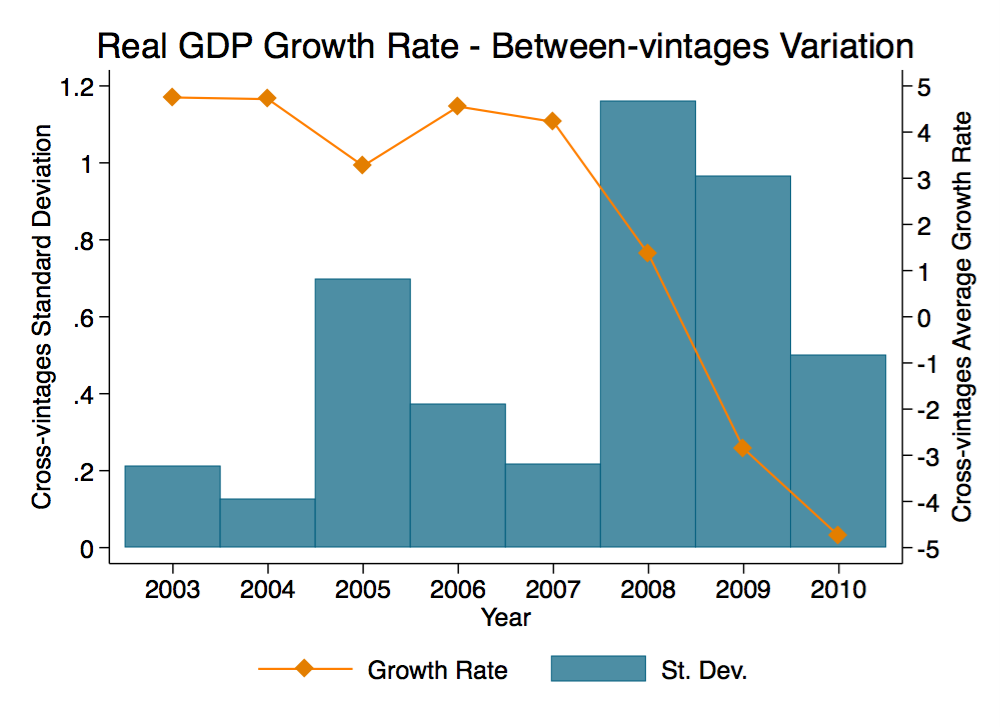
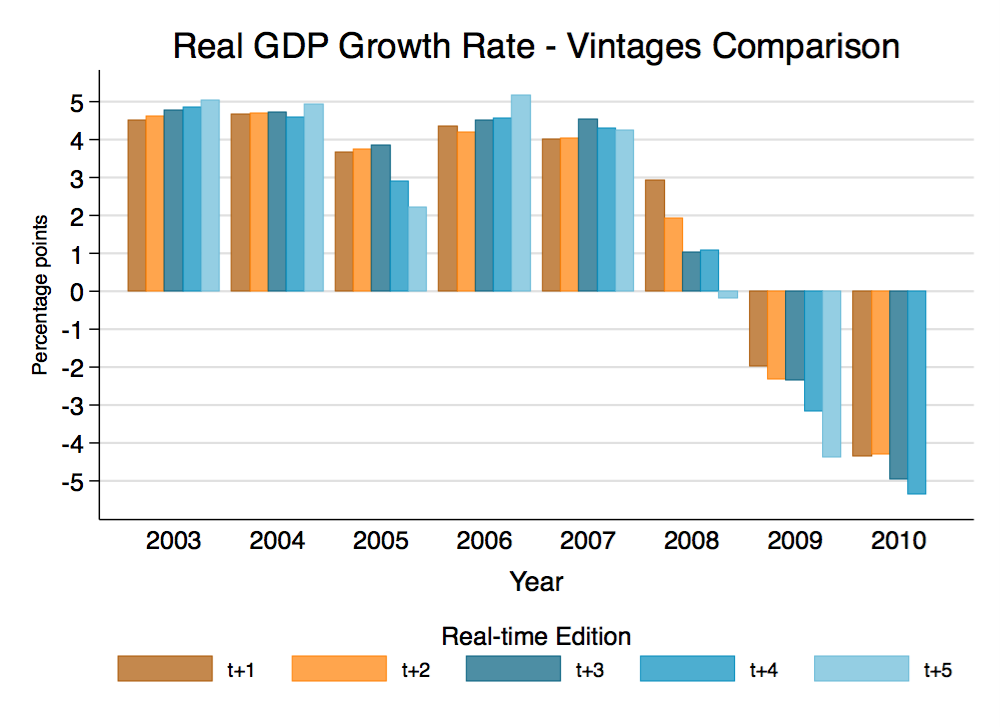
Figure 1 shows the revisions of real GDP growth in the October of the year of the first release and the 4 subsequent years. Similarly, Figure 2 plots the Greek real GDP growth rates over the last decade averaged over the first five available vintages together with their standard deviation. Two things emerge from these figures. First, revisions can be large (as much as 3.12 percentage points in our sample) and the value does not seem to converge necessarily to a steady value in the short run. Second, revisions seem to be bigger during the crisis. A similar pattern emerges when analyzing GDP vintages of the UK, as if statistical offices have more difficulties to calculate GDP in a recession.[3] This might be a source of extra-concern, since it suggests that GDP estimates are less accurate exactly in the moments in which GDP-linked bonds are of more importance.

Figure 1: Each column represents the growth rate of the considered year t, according to the first five real-time data releases, which take place starting from t+1. We use October’s vintages from years between 2004 and 2012. In years 2013 and 2014 October’s vintages are not available, so the July and December’s vintages have been used, respectively.
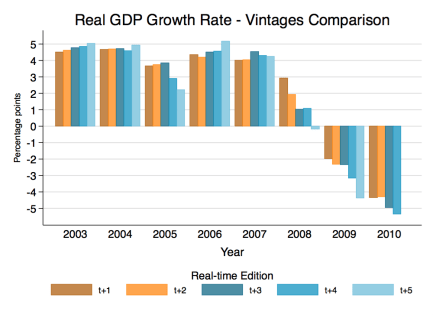
figure1

Source: OECD Stats – stats.oecd.org.

Figure 2. The orange line represents the real GDP growth rate averaged across vintages, while columns depict the cross-vintages standard deviations. Both statistics are computed using the first five data releases. We use October’s vintages from years between 2004 and 2012. In years 2013 and 2014 October’s vintages are not available, so the July and December’s vintages have been used, instead.

figure2

Source: OECD Stats – stats.oecd.org.

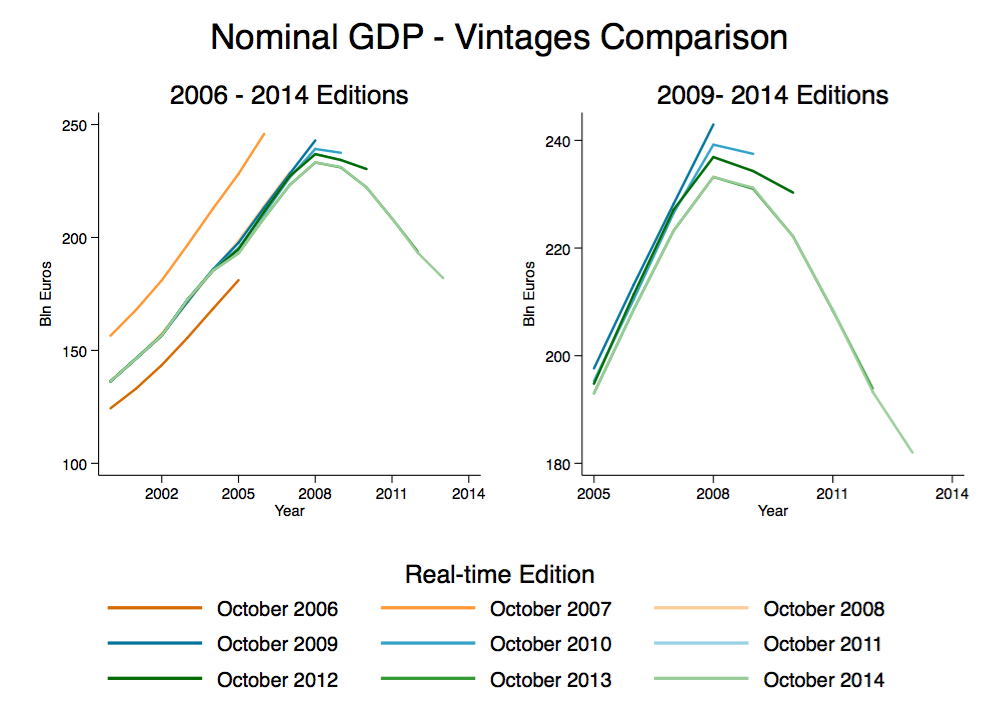
The swings in real GDP estimates are only in part due to revisions of the price indices. Figure 3 reports the nominal GDP estimates released between October 2006 and October 2014 and shows that the nominal series is not immune to changes across years. The differences between October 2006 and 2007 and the other real time editions is striking, but as the second panel shows more recent data are far from being consistent.

Figure 3: The left panel plots all the series released between October 2006 and October 2014. The right panel focuses on the difference of the 2009-2014 series.
figure3

Source: OECD Stats – stats.oecd.org.

Discussion

Keeping the payout scheme described in the first section in mind, the figures above show that large changes in the revision seriously weaken the argument in favor of GDP-linked bonds because they would significantly alter yearly payments and cast doubts on the accuracy of GDP estimates. In 2008, for instance, the GDP-linked bonds would have turned out to be pro-cyclical since the growth estimate in October 2009 was around 3%. Moreover, as feared by Borensztein and Mauro (2004), investors could feel cheated by such changes in the revision.

Borensztein and Mauro (2004) suggest that it is unlikely that governments would consistently under-report their GDP figures, since it is easier to be re-elected when the economy is strong and growing. However, this automatic control mechanism might not be fully working when payments are allocated with a lag compared to when the first growth estimate is released.[4] In this case, it might be possible for politicians to get the political benefits of announcing a high growth rate and then revise the figures downwards before the payments. For example, the first release of national account data for each year, according to OECD vintages, is usually released in March of the following year. The Government can therefore benefit from the March announcement and then revise downwards before the October payments.

There might be three ways around this issue. First, as proposed by Panizza (2015) repayments could be smoothed over long periods. This approach has the downside of partially weakening the counter-cyclical benefits of GDP-linked bonds. Second, one might take the first published GDP figures as the ones used for repayments. However, such figures are usually quite unreliable since they are published in the first quarter of the successive year, when data are still preliminary. Third, the bonds could be linked to the maximum of the GDP figures published from the first quarter to the moment of the repayment. This way, the incentives of strategic reporting would be reduced.

Conclusions

GDP-indexed bonds have appealing properties and might represent a viable way for reducing Greek debt without haircuts. However, the reliability of the data and moral hazard related issues might be of some concern for investors. It is therefore important to come up with mechanisms that reduce the incentives of strategic reporting and with rules to deal with data revision and mis-measurement. A possible solution is to index the bonds to variables out of a country’s control as proposed by, among the others, Krugman (1988) or that can be measured by third-parties (as it is the case of, for example, the debt-to-exports ratio). In any case, reference values should be forecasted and discussed by all the parties involved or outsourced to an independent institution.

References

Borensztein, Eduardo and Mauro, Paolo (2004), “The Case for GDP-Indexed Bonds,” Economic Policy, 19(38), pp. 165-216.

Gulati, Mitu, Trebesch, Christoph and Zettelmeyer, Jeromin (2013), “The Greek debt restructuring: an autopsy,” Economic Policy, 28(75), pp. 513-563.

Krugman, Paul (1988), “Financing vs. Forgiving a Debt Overhang,” Journal of Development Economics, 29, pp. 253-268.

Panizza, Ugo (2015), “Debt Sustainability in Low Income Countries: The Grants versus Loans Debate in a World without Crystal Balls,” FERDI Working Paper No. 120, February.

Footnotes

[1] Financial Times, February 2, 2015. Available at: http://www.ft.com/intl/cms/s/0/7af4252c-ab03-11e4-91d2-00144feab7de.html#axzz3Qmwhjogc.

[2] The Metadata Explanatory text explains that the data sources for national accounts are National Statistical Institutes. The whole disclosure is available at http://ec.europa.eu/eurostat/cache/metadata/EN/nama_esms.htm.

[3] See http://www.measuringworth.com/uk-gdp-volatility.php for an analysis of UK GDP revisions.

[4] This is likely to be the case here, since it takes some time before GDP estimates are finalized.
The Ethiopian Energy

The other day I read this article on BBC news about the Grand Ethiopian Renaissance Dam, and since in my previous life I worked on the topic for a certain amount of time, I thought it might be interesting to add some insights that are usually not reported in the news.

Ethiopian government has been working on one of the biggest projects that Africa has ever seen: a dam on the Nile that would generate enough electricity to cover the need of the entire country plus some surplus that would be sold to neighbor states. The project is interesting for a series of reasons: First of all, it would provide a _steady_ supply of _clean_ energy to the country and its neighbors. Second, after the initial investment, the cost of production of hydroelectricity is relatively small and countries like Eritrea would be able to buy electricity at a price which is almost one half of their current production costs. Third, the dam was thought to be modular: After the construction of the dam, the turbines (which are the expensive part of a hydroelectric power plant) can be added one by one. So, one can imagine that if the funds become scarce, the authorities will only install a couple of turbines and start selling the electricity produced that way, adding the remaining turbines only in a second moment.

The construction works only started few years ago, but the dam on the Nile has been a myth every Ethiopian grew up with since the 60s. Actually, I was told by an Ethiopian lady that already her grandfather talked about this dam and that its realization is generally seen by Ethiopians as the definitive solution to every economic problem of the country. In the past years, the government has been following quite aggressive policies to raise the necessary money for the realization of the project, and mainstream media have been depicting these practices as the evil consequences of a not-very-democratic government. However, in the light of the words of the lady, it is easy to understand why some years ago all the public employees voluntarily gave up part of their stipends to finance the dam. It is also easy to understand why a big chunk of the debt is held by Ethiopians themselves. Now, one might be wondering whether it is true that this project is going to be the panacea of all their problems, and if that is what Ethiopians believe, why has the building started only recently.

The answer to the latter question is pretty easy: until 2011 Egypt still had a lot of influence on the region and was strongly supported by Western powers. For Egypt a disruption of the flow of the Nile might have major consequences on its agriculture and therefore has always opposed the project. After the 2011 Egyptian revolution, its position weakened importantly and authorities were more concerned about internal stability than about their external interests. That was the right moment to start building the dam.

The answer to the former question, on the other hand, is more complex and as it usually happens it depends on who you ask to. In the past 4 years the Ethiopian economy has been literally squeezed to fund the project. People have been highly taxed to collect funds and the National Bank, which owns about 80% of the market share and not only is in charge of the monetary policy but also engages in normal banking activities, artificially set the interest rate on loans lower than the inflation rate and the rate of return on capital. In such an environment, it is almost impossible for private banks to survive. This is usually referred to as financial repression, even though (surprisingly enough) Ethiopian authorities do not really like the term. Of course, Western organizations like the IMF have some concerns about the sustainability of this situation and would like to see more involvement of the (Western) private sector. In particular, now that the country started tapping on international markets to finance their debt, there are some major concerns on debt sustainability. On the contrary, Ethiopian authorities ensure that everything is under control and that when they will start selling energy to neighbor countries they will have enough profits to repay everyone.

I guess that at this point history will tell us who is right and who is not: The project has started and Western countries have their hands tied: Ethiopia is one of the few stable countries in the region and therefore plays a key military role there. In particular now, with the dire situation in South Sudan, it is important to keep good relations with Ethiopia and avoid to annoy the authorities.

Small Technical Appendix to the Ethiopian Post

Modeling an economy with financial repression is a pretty hard task and needs some non-standard tricks. In fact, standard economic theory suggests that real interest rates can never be smaller than the rate of return on capital since at that point demand for credit would be infinite. That is not what happens in reality because the government not only sets the interest rate but also the supply of credit in the economy. Some people are willing to pay more to get credit, but who cares? The only person I know of who has been working on this is Edward Buffie at Indiana University. In his model, interest rates are given exogenously, and the financial sector explicitly modeled to take into consideration seniorage. Even though people like Blanchard think that macroeconomics does not even exist when applied to developing countries, I reckon that it is pretty interesting to see how concepts that are taught in any macro course and that students take as given and reasonable are reasonable only because Western economic agents and governments think that way, but there is no reason to have an economy that works with other paradigms. Maybe it is not efficient but in the end it all depends on one’s loss function, right?

Users of all lands, unite!

“Information is power. But like all power, there are those who want to keep it for themselves.” This is how Aaron Swartz‘s Guerilla Open Access Manifesto begins. His manifesto concentrates on free access to scientific publications. I certainly sympathize for that view, but that is not exactly the topic I want to talk about. The idea of this post is to start from the quotation above and analyze it in the context of personal data. This topic has been in the spotlight for quite some time now, in particular after the NSA scandal. However, here I am not directly concerned about governments collecting data for intelligence, I am more concerned about firms whose business is strictly related to data collection.

With the risk of stretching things a little bit, it seems to me that we are slowly going towards a society that is divided into two parts. Those who own behavioral information about their users and the users who provide it. This to me is somehow reminiscent of the class division that was experienced during the first industrial revolution. By analogy with capitalists and workers, I am going to call the information owners, informationists, and the people who provide the data, users (in a first version of this post I tried to called them “daters”, that in my opinion was a more appealing name, but then I realized that they sounded more like latin lovers than data providers). Some people might argue that this has always been the case: To a certain extent, companies has always been informationists and consumers has always been users. Companies always tried to collect as much information as possible in order to target their products and price discriminate among consumers. For example, a thing that few people know is that the message: “This phone call may be recorded for quality assurance purposes”, does not imply that there might be a supervisor listening to the phone call, or that the phone call is going to be used in some training session. In many cases, it actually implies that the conversation is used to train an artificial intelligence that listens to customer calls together with the operator and based on her tone of voice and answers, it suggests which offer the user is more likely to accept. So, it is probably true, that even more traditional businesses have always collect data about their costumers to target their products, but in the last 10 years, thanks to the Internet and an exponentially increasing computational power, informationists have been able to collect an unprecedented amount of information about the behavior of their users. Now, they do not only know what products I am buying, they know when I wake up in the morning. Moreover, the business model of informationists is completely different. Traditional companies collect information to sell real products, informationists usually offer free products to collect behavioral data. Data are no more the mean, they are the goal. Just last week IBM announced they are going to offer an AI service in the cloud to allow mobile developers to make use of artificial intelligence more heavily. Artificial intelligence needs user data in order to learn and do meaningful things.

Now, do not get me wrong I do not want to sound like a Luddite. I think this process is irreversible (like industrialization was) and that is actually going to be beneficial for users in the long run. However, I reckon that this process is not free of difficulties. Control of something like behavioral data might be quite dangerous and create big differences between who has access to the data and who has not. We should start studying more closely this phenomenon and similarly to what was done in the last century create some sort of associations to protect users rights. The power of informationists comes from their monopoly over information. What if users started collecting data themselves in a systematic and anonymous way and share them freely? Similarly, we might need commissions that monitor what kind of data are collected and for which purposes. It might be said that this would slow down innovation, but in the end medical/pharmaceutical research has had to comply with pretty high ethical standards for some decades now and, still, it remains a quite innovative field. At least, we would probably need independent people (i.e., people not paid by informationists) who start thinking about some issues related to AIs that are more and more able to predict our behavior (see for example Google Now) and therefore, potentially, to behave like us. For example, what is going to happen if we were to reach a point close to the technological singularity? Who would be in charge? Should development be stopped at that point? Governments should probably be responsible to provide answers to these questions (in the end it is key for their survival, too), but I doubt that we are going to see any step in this direction as long as policy makers do not even know the difference between the IPv4 and the IPv6. I am not saying that everyone should know it, just someone in the legislative process. But this is probably going to be the topic of another post.

Thinking in these terms gives a whole new view of high-tech companies. When Facebook was quoted on stock markets its market capitalization was around 90 billion of dollars (more than 170 now). Some people started screaming “Bubble!” and, to be honest, I was one of them. I could not understand how a social network like Facebook which at that time was not doing much profits could be quoted that high. Rethinking about this now, I was looking at the thing from the wrong point of view. “Information is power”. And power easily transforms into money, I would add. It is not important how much actual money a high-tech company is doing. An informationist by its own nature is only concerned with the number of users it has. That is the only thing that matters. Sooner or later those data will become of some use. Maybe (probably) in ways we have not thought of, yet.

Random Technical Ideas Related to the Informationist Post

Random technical questions and ideas I came up with while writing this post:

– Data: How valuable does the market think is this information? How has its valuation changed in the last decade? How to measure it? An idea may be to take market capitalization of traded informationists subtract the expected stream of revenues and what is left is a noisy measure of the potential of information. Of course, this method only captures traded companies.

– Theory: Where does this value come from? Endogenous preference formation? That is, are informationists able to tilt our preferences towards certain products/behaviors? Can firms buy this information (e.g., advertisement spots) to affect our preferences? Theoretically, in equilibrium this should lead to a zero impact since every firm should be wanting to do that. Maybe that is exactly where the value comes from: Everyone has to use it, because otherwise they would lose their piece of market. Or maybe preferences are tilted towards informationists that are able to collect even more data about their clients and so on. Is there some cool mechanism here? Something like: Diminishing returns of capital => exploitation of workers => revolution.

Disclaimer

The beginning is always the most difficult part. It is like when you make a bet and toss a coin. The moment your finger starts the movement is the moment that takes your breath away. Once the coin has started its inexorable trajectory – headstailsheadstailsheadstails – once the coin is in the air, some sort of peace fills your spirit. In that moment you know that you are just in the hands of Destiny, of something that in any case is beyond your control. It is not then, but when you still have the illusion that you have a choice that hundreds of doubts and what-ifs fill your mind.

I have been thinking about this blog for some time now, and probably the freezing Midwestern winter is a good moment to start this new project (or to try at least). Some years ago I moved some steps in the world of blogs with scs.uaz.ch, and I remember that in the three years I maintained it I had a lot of fun. When one blogs something, everything becomes a little bit more important. Even if you know that very few people will read it, the fact that an idea, an experience, a thought, no matter how stupid it is, is there and that you can go and look back at it whenever you want and laugh and frown, makes things somehow  special. Moreover, this time everything is going to be in English and hopefully my writing skills are going to get better with time (which is always a quite desirable side effect).

The initial idea was to have a sort of literary sandbox where I could come and experiment with; a sandbox where ideas could be fixed. Sometimes thoughts go lost just because one does not take time to sit down, think about them a little bit and structure them. The majority of times it is just nonsense, but I think it is still worth it to give them a try. Quoting an old movie: “No matter what anybody tells you, words and ideas can change the world” – if anything, five years from now I will have the sure proof of how useless all this was. Then I realized that I know people that would have even more interesting things to say, people with whom I had great discussions. Some of them are scattered around the world and I thought it would be great if they were willing to share their experiences, their intuitions. Anything. Research, personal projects, hopes, dreams, reflections. Anything, they consider that is worth to share in a somewhat more formal, yet more experimental (and maybe more intimate), setting compared to, say, Facebook. And it is from this that the subtitle of the blog comes from. I am firmly convinced that life experiences and ideas are made to be shared, otherwise what is the whole point? Perhaps, one day I will open this website and I will see a new post from someone that I do not even know. So, what is going to be the topic of this blog? Everything or maybe nothing. I have always been a big fan of emerging behavior.